TL;DR: OpenAI Ads are early-stage, opaque, and lack key controls—for now, organic search delivers far better ROI
We put NZ$500 to work on OpenAI Ads Manager in Waikato. The ads sit awkwardly at the bottom of the chat, offer zero query transparency, and lack basic optimisation levers. Interestingly, our cheap placeholder Reach campaign accidentally beat our Conversion campaign on leads. Organic search remains king for performance today, but with Google releasing AI search ads to PMax and AI Max in NZ later this year, AI media buying is set to mature fast.
Whenever a new ad platform launches, the digital marketing industry immediately splits into two camps: the hype-train believers and the vocal sceptics. At Unbound, we prefer to put real budget on the line and see what actually happens. We ran a real-world test in Waikato, putting roughly NZ$500 into the new OpenAI Ads Manager.
Here is the candid breakdown of what happened, what worked, and where the platform still feels like driving in the dark with the headlights off.
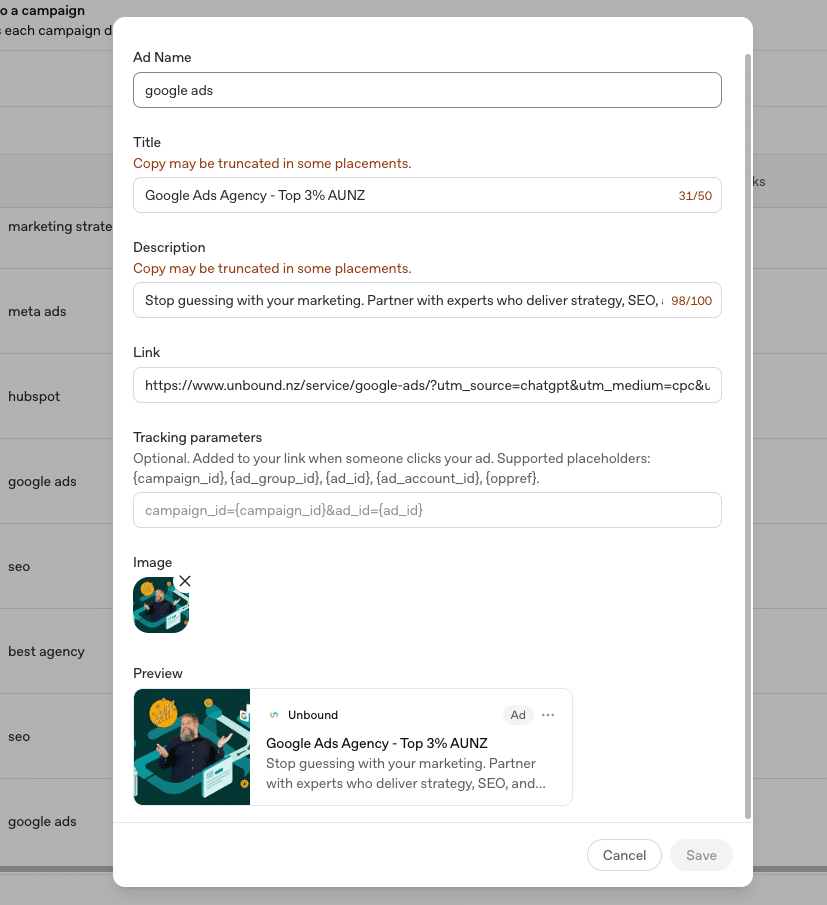
Tacked On at the Bottom: The Placement Problem
The first thing you notice when running ads on ChatGPT (OpenAI Ads) is where they actually land on the screen. When someone asks a query—like looking for a local accountant in Hamilton—the ad doesn’t integrate naturally into the conversational answer or recommendation list.
Instead, it sits awkwardly in a standalone card pegged to the very bottom of the chat, beneath all the text and source links. It feels tacked on, out of context, and disconnected from what the user is actively trying to solve in that moment. Because it sits outside the conversational flow, users can easily scroll right past it.
The Accidental Conversion Winner
While setting up our main Conversion campaign, we spun up a quick Impression (Reach) campaign as a temporary placeholder while waiting for our conversion tracking events to be verified.
When we pulled the numbers, the placeholder campaign delivered a surprising result:
-
Conversion Campaign: Spent NZ$482.43, generated 17,867 impressions and 85 clicks. Total conversions: 0.
-
Reach Campaign: Spent NZ$96.51, generated 3,019 impressions and 12 clicks. Total conversions: 1.
The cheap awareness placeholder accidentally beat our dedicated performance campaign on actual leads. It is a classic digital marketing reality check that early-stage ad algorithms do not always behave how you expect.
Flying Blind in the ChatGPT Black Box
Placement quirks aside, testing OpenAI Ads highlighted two major functional limitations:
-
Query data blackout: You get basic metrics on impressions, clicks, and spend, but zero visibility into the exact prompts that triggered your ad. Did you show up for someone looking for a Hamilton digital marketing agency, or someone asking for a soup recipe? You simply do not know.
-
No optimisation levers: There are virtually no knobs to turn under the hood. You set your budget, pick a location, upload creative, and take a “trust and see” approach.
Organic Search Still Wins (For Now)
Right now, we get far better, higher-converting results from simply being found in organic search. Earning organic recommendations in generative AI answers and traditional search engine results drives qualified leads who are actively seeking solutions, rather than catching someone mid-prompt with a bottom-of-page ad.
That dynamic will shift as AI advertising matures. Google will be releasing its AI search ads through Performance Max (PMax) and AI Max later this year in New Zealand. Because Google sits on decades of search index data and understands deep query context, those placements will likely feel much more contextual and seamlessly integrated right out of the gate.
What We’re Doing Next
We are not turning it off just yet. Judging an early-stage ad platform on a brief test window is a mistake. Machine learning models need time and data volume to figure out intent matching. Our plan is to run it for longer, collect more data, and evaluate performance over a broader timeframe.
What OpenAI Needs to Build Next
If OpenAI wants performance marketers to shift serious budgets, they need to give us proper levers:
-
Query match & intent data: Aggregated insights into prompt topics so we can judge query relevance.
-
Negative query & sentiment controls: The ability to exclude irrelevant prompt topics and prevent ads from appearing alongside negative sentiment.
-
Dynamic Search Ads (DSAs): Crawl our website, identify the most relevant landing page for a specific prompt, and send users straight there.
The Bottom Line
OpenAI Ads feels a bit like Google AdWords back in 2002—unrefined, opaque, but loaded with potential. For now, make sure your organic search visibility is locked down, keep test budgets modest, and watch closely as AI media buying evolves.


