
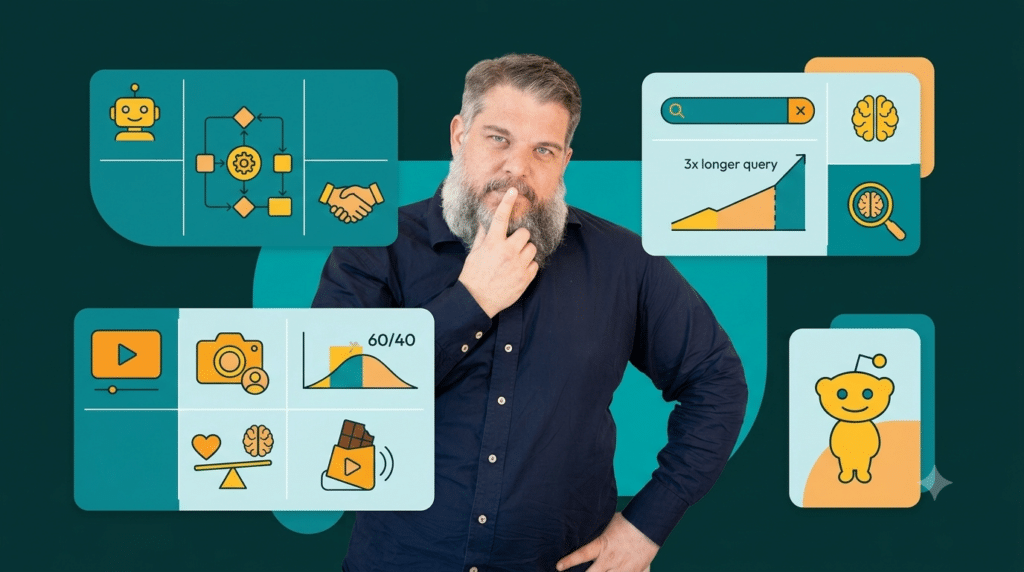
Last week, Helen and I made the trek up from Waikato to Auckland for Digital Day Out 2026. It was a foggy morning and an early start on the road, but we had a full car to keep us company – Pooja from Ebbetts caught a ride with us, and former Unbounder Hannah was in tow as well. We managed to beat the worst of the morning motorway traffic, arrived right on time, and grabbed a hot coffee on our way through the doors.
Now in its 16th year (“Sweet 16”, as the hosts kept reminding us), New Zealand’s flagship digital marketing conference brought together more than 550 marketers to unpack where the industry is heading.
The day covered a massive amount of ground: autonomous AI agents, agentic commerce, creator culture, Reddit search optimisation, brand building, and creative effectiveness.
Below is our comprehensive breakdown of every speaker, what was presented, the practical takeaways for marketers, and our honest assessment of what hit the mark – and what fell short.
Welcome & Event Housekeeping
Vanessa Williams
MC & Marketer, RealEstate.co.nz
Vanessa Williams opened the day by welcoming the 550-strong crowd and celebrating 16 years of Digital Day Out.
She ran through the event logistics, reminding attendees to download the official event app to keep track of the agenda, submit live questions for speakers, connect with other marketers in the room, and rate each session to earn points on the leaderboard for end-of-day prizes. She also noted that presentation slides (from approved speakers) and the post-event survey would be emailed out by the Marketing Association following the event.
Jennifer Michtavy
Creative Technologist & AI Systems Design
In a brief intro, Jennifer Michtavy set the stage by explaining her day-to-day focus: building and deploying AI systems directly in live commercial environments. Rather than testing concepts in isolation, she builds tools that run on real campaigns, live customer interactions, and actual working budgets, emphasising that the most interesting industry conversations happen when AI meets practical execution.
1. AI Search, Agents & Machine Learning
Caroline Rainsford
Country Director, Google New Zealand
Caroline Rainsford opened Google’s segment by highlighting local AI applications across Aotearoa. These included Google’s partnership with the Cochlear Institute to deliver personalised hearing aids, using AI vision models in breeding programs to help save the endangered Takahē bird, and launching the first official Kiwi voice in Google Maps, engineered to accurately pronounce Te Reo Māori place names (sharing a personal story of how her kids love hearing correct pronunciations on family road trips down Karangahape Road).
She declared that marketing has officially entered the Agentic Era, powered by models like Gemini 3.5 and Gemini Omni. AI is moving from generating static content to autonomously executing multi-step tasks.
Search Evolution & AI Max
Rainsford shared that Google’s AI Overviews now reach more than 2.5 billion monthly users globally, while AI Mode (conversational search) has surpassed 1 billion monthly users, with queries growing 3× longer than traditional keyword searches.
To help marketers capture these nuanced user queries, Google highlighted AI Max for Search and Performance Max, which is driving an average 27% increase in global conversions. She closed by introducing the concept of the Trust Line: as search becomes more conversational, consumers move faster from discovery to purchase decision, provided they trust the underlying platform.
Key Takeaways from Caroline Rainsford:
- Prepare for Agentic Workflows: Tools like Gemini 3.5, Gemini Omni (multimodal media generation), and Gemini Spark (Google’s 24/7 personal agent) shift AI from content creation to autonomous task execution.
- Optimise for Deep Intent over Keywords: AI Mode queries run three times longer than standard searches. The best-performing ad is simply the one that provides the most accurate, trustworthy answer when a consumer asks a complex question.
- Leverage Platform Trust: Conversational buying requires high trust. Showing up on established platforms helps brands cross the “Trust Line” to drive conversions.
Britney Muller
Founder, Orange Labs & Machine Learning Consultant
Streaming in live via Zoom, Britney Muller demystified how Large Language Models (LLMs) function. She explained that traditional SEO is like placing a product on a store shelf, whereas AI search is like getting a direct recommendation from a store employee.
How LLMs Actually Work
Muller stressed that LLMs are fundamentally probabilistic averaging machines. They output what is statistically common across their training data.
To demonstrate, she showed examples of AI image generators struggling to render a left-handed golfer or a glass filled to the exact brim with wine – because those images are statistically rare in training sets. She also showed AI-generated images of a “2024 Auckland Tech Marketing Conference” and a “May 18, 2024 New Zealand Herald newspaper,” pointing out that base LLMs are out of date the moment they are released.
Because base models lack real-time data, AI search engines rely heavily on real-time web retrieval (System 2) to supply current context.
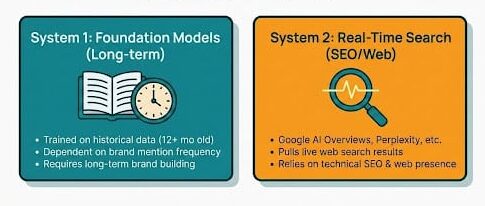
The 3 Pillars of AI Search Visibility
To show up in AI search answers, brands must focus on three areas:
- Be Understood (Visible): Maintain technical SEO, clear site structure, and consistent brand entity definitions.
- Be Trusted (Authority): Earn PR and media citations across authoritative web sources. Brand mentions are the new backlinks.
- Be Discussed (Community): Participate in community conversations on platforms like Reddit, which accounts for roughly 24% of Perplexity citations.
Closing the Execution Gap
Muller noted that 90% of marketers talk about AI, but only 10% actively build with it. The primary hurdle is a fear of imperfect execution. She advised teams to drop perfectionism and ship an “Ugly V1” – getting a messy prototype running quickly to see what breaks, then refining it.
She showcased several real-world custom workflows built by her students:
- Martin Camtola: Built a live sales support agent using Base44 and Claude that listens to live sales calls and prompts reps in real time (e.g., “You’re rambling, ask X question”). He also built custom in-house SEO tracking software using APIs.
- Joe Rogel: Combined Ahrefs API data with Claude in CoWork to build interactive client reports, publishing them instantly to public links via Netlify Drop.
- Kelsey Rice: Developed a custom Chrome extension for internal link recommendations, open-sourcing the code on GitHub.
- Maddie Osmond: Built a Zapier agent that harvests HARO PR request emails from her inbox, matches them against internal blog topics, and drafts press responses automatically.
- Federico Pasqual: Built a LinkedIn outreach workflow connecting PhantomBuster, Google Sheets, and LLM prompts that achieved an 80%+ response rate, which he commercialised into tools called Thile and WordCrafter.
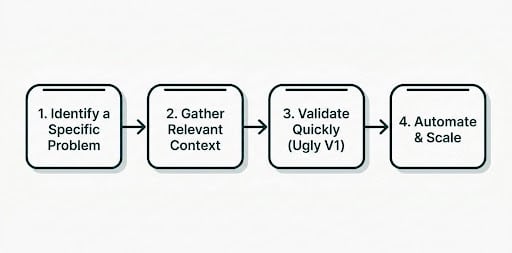
The 4-Step AI Mental Model
- Identify a Specific Problem: Start with a clear, small task. (If the task description contains the word “and”, it is too complex).
- Gather Relevant Context: Feed the system clean, proprietary data.
- Validate Quickly (Ugly V1): Test immediately without overbuilding.
- Automate & Scale: Once validated, connect APIs and scale.
Tool Stack & Prompting Tip
Muller recommended Claude CoWork + MCP (Model Context Protocol) connectors to link LLMs directly to local files, Drive, Slack, and Gmail without writing code. She also highlighted NotebookLM for querying complex internal PDF documents.
Her top research-backed prompting secret is Few-Shot Learning: instead of writing a lengthy instruction, provide the model with 2 to 3 real examples of “good” outputs and examples of what to avoid.
Key Takeaways from Britney Muller:
- Ship an “Ugly V1”: Focus on fast validation rather than perfect planning. Finding mistakes in a prototype tells you exactly what to fix.
- Brand Mentions Are the New Backlinks: AI search relies on community discussions and third-party web mentions to validate facts.
- Specificity is the Strategy: AI struggles with rare edge cases. Publishing detailed, highly specific middle-and-bottom-of-funnel content forces AI search engines to cite your brand because no alternative answer exists.
2. Creator Economy & Authentic Community
Caroline Oates
Head of YouTube Programmatic Media AU/NZ, Google
Caroline Oates explored how the media landscape has shifted from an attention economy to a connection economy. Creators are no longer a side channel; they represent the new entertainment industry, filling stadiums and building media networks.
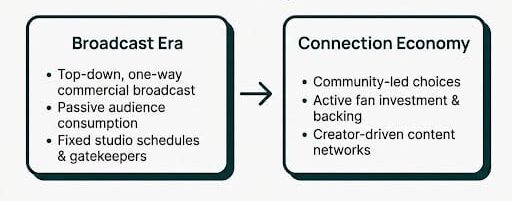
Creators as the New Hollywood
Oates highlighted major creators like MrBeast (488M subscribers), Amelia Dimoldenberg (Chicken Shop Date), Alex Cooper (Unwell Network), and the Sidemen, alongside local New Zealand powerhouse Viva La Dirt League. Starting as a group of Auckland mates filming gaming comedy sketches, Viva La Dirt League has grown to over 7.4 million global subscribers and built their own state-of-the-art production studio in Auckland.
She shared that over 1 million hours of content were uploaded by New Zealand YouTube channels in the past year alone. Consumption spans short-form Shorts, long-form podcasts, and living-room Connected TV screens.
Crucially, research shows that 73% of surveyed Australian viewers trust creator opinions on products, and 68% view brands more positively when they partner with creators they trust.
Brand Case Studies
- Canva: Shifted its YouTube strategy toward creator partnerships, delivering a 9% increase in Pro trials at an 8% lower Cost Per Acquisition (CPA) compared to standard ad formats.
- Unilever (Liquid I.V.): Allowed creator Pierson (7.2M subscribers) to take over their channel and produce a custom, lo-fi ad, resulting in significantly higher view-through rates than traditional commercials.
- Neon NZ: Partnered with local creator KyleeDeThier for a Euphoria makeup tutorial series to drive engagement around streaming releases.
Key Takeaways from Caroline Oates:
- Move from Broadcast to Collaboration: Brands no longer get to broadcast at audiences; they must earn an invitation into creator-led communities.
- Trust Creator Formats: The most effective creator integrations start with what the creator already does well rather than imposing a corporate script.
- Relevance Requires Multi-Format Reach: Audiences move fluidly between 15-second Shorts, long-form videos, and TV screens.
Hannah Fillis
Head of Digital Marketing & Media, Mecca
Hannah Fillis detailed how beauty retailer Mecca (founded 28 years ago by Jo Horgan) has built a community of 4.6 million customers, 7,000+ team members, and 110+ stores across Australia and New Zealand.
Fillis emphasised that community cannot be labelled or forced – it must be earned by listening first and giving customers an active role in the brand.
Social Principles & Authentic Stars
Mecca filters all social content through three questions: Is it Educational, Exciting, and Engaging?
Instead of relying solely on polished studio shoots, Mecca’s top-performing social content stars their frontline store team members (“beauty fairy godmothers”) and head-office staff (such as Car, a web developer who candidly tries products on camera). Videos featuring real team members consistently outperform engagement benchmarks by 20% to 100% because their enthusiasm and relatable reactions are genuine.
Community Participation & Cultural Moments
- Listening Tools: Mecca created Mecca Chat, a private Facebook group that organically grew to over 100,000 active members. Mecca uses it as a live focus group to gather direct feedback.
- Creator Collaborations: When launching Troye Sivan’s fragrance line (Sol de Janeiro), rather than filming a formal interview, Mecca brought Troye into their head office for a day to work reception, make tea, and interrupt meetings. The resulting lo-fi content matched native social formats.
- Burke Street Flagship Launch: For the launch of their 4,000 sqm flagship store in Melbourne, Mecca built multi-week anticipation on social (including giant puzzle pieces moved across the city). Creator coverage generated 94 million impressions, driving customer queues down the street from 4:00 AM on opening day.
- Australian Open (AO) Partnership: Mecca built a 3-story “Mecca Pro Shop” courtside at the AO. When two fans posted a viral TikTok getting stuck on the top floor (calling it the “Barbie Dream House”), Mecca reposted and joined the joke rather than shutting it down. The campaign generated over 1,500 creator posts.
Key Takeaways from Hannah Fillis:
- Feature Frontline Talent: Real employees with genuine product passion build stronger trust on social channels than scripted actors.
- Design for Customer Participation: Give customers, staff, and creators an active role in storytelling rather than treating them as passive viewers.
- Listen Before You Act: Use community groups and social comments to identify what customers actually want before designing campaigns.
3. Culture-Led AI Execution
Dean Napier
Head of Marketing, Trade Me
Dean Napier presented a pragmatic case study on driving AI adoption across Trade Me. With over 320 million listing views a month and no physical retail stores, Trade Me operates as a digital-first business.
Napier stressed that AI adoption is a cultural transformation, not a technology rollout. To build capability, Trade Me implemented four key initiatives:
- Hands-On Training: Partnered with PwC for practical team workshops.
- Weekly 30-Minute Check-Ins: Held agenda-free weekly catch-ups for the marketing team to share wins and failures.
- Dedicated “AI Power Hours”: Blocked out 1:00 PM to 3:00 PM every Wednesday as dedicated AI time – no meetings, no routine work, just hands-on experimentation.
- Leadership Support: Executive buy-in and clear guardrails gave staff psychological safety to experiment.
Workflow Redesign & Tools
Trade Me mapped out routine marketing tasks using Miro/Lucid, focusing on two key operational areas:
- Product & Campaign Launches: Shifted market validation, brief writing, and creative concepting into AI tools. Using Gemini for campaign planning cut preparation time from 3 days down to 1 day.
- Lifecycle Marketing: Automated data modelling and campaign logic across 80+ active trigger campaigns using Claude Code and Braze AI Operator, reducing data analysis time from weeks down to days.
Overall, Trade Me achieved a 7× increase in operational efficiency across these lifecycle workflows.
Golden Rules for AI Adoption
- Map Before You Move: Clearly document every manual step in a workflow before attempting to automate it.
- Build Small, Specialised Agents: Smaller agents assigned to specific tasks (e.g., a brief writer agent, a quality check agent) produce far better outputs than one large agent trying to do everything.
- Maintain Quality Control: Establish an internal AI Governance Forum (legal, privacy, security, data) to ensure brand safety and data protection.
Key Takeaways from Dean Napier:
- Protect Time for Experimentation: Providing tools isn’t enough; staff need dedicated, meeting-free hours to build confidence.
- Focus on 20/80 Friction Points: Target repetitive, manual processes (like brief writing or data cleaning) where AI delivers immediate time savings.
- Share Learnings Centralized: Create a central prompt and agent repository across departments to prevent teams from re-inventing solutions.
4. Creative Bravery & Effectiveness
John Mescall
Executive Creative Partner, Dentsu Creative
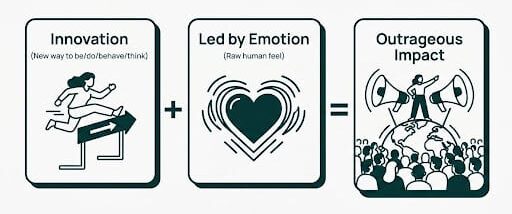
John Mescall delivered a passionate presentation on the central role of emotion in creative work. He introduced his core formula:
Innovation Led by Emotion = Outrageous Impact
Mescall defined innovation broadly: any new way to be, do, behave, think, or function (tech-based or otherwise). However, logic alone never changes human behavior. To compel an audience to feel something, marketers must feel it first.
Anger as Creative Fuel
Unpacking two of the most culturally impactful campaigns of the last 15 years – Dumb Ways to Die and Fearless Girl – Mescall revealed that both were fueled by raw anger:
- Dumb Ways to Die (Melbourne Metro): Born from frustration over people acting recklessly around train tracks. The creative team channelled that anger into calling out the sheer stupidity of train accidents, disguising the message inside a catchy, adorable animated song.
- Fearless Girl (State Street / She Fund): Born from anger toward the machismo and patriarchal culture of Wall Street. To promote a fund that invests in women-led businesses, they placed a small bronze girl directly opposite the iconic Wall Street Charging Bull. Designed with the ambition to feel like a permanent NYC fixture from day one, it stood its ground for 2.5 years.
Raising the Ceiling in the AI Era
Mescall pointed out that AI will soon make “totally okay” execution accessible to anyone. Technology lifts the floor of baseline execution. Therefore, human marketers must raise the ceiling by leaning into emotional risk, craft, and distinctiveness.
Key Observations on Current Culture
- Moving at the Speed of Culture Can Kill You: Chasing fleeting social trends provides short sugar hits. True brand equity requires shaping culture over time.
- Extreme Pragmatism Drives Great Work: When a problem must be solved, teams become pragmatic enough to try radical ideas.
- Cultural Norms > Universal Truths: Specific cultural quirks, oddities, and local subcultures are far more interesting to audiences than broad, generic human truths.
- No Rules Remaining: The traditional marketing playbook is dissolving. Marketers should feel empowered to follow problems wherever they lead.
Key Takeaways from John Mescall:
- Emotion Comes First: Every campaign must start with a genuine emotional spark; logic alone will not shift human action.
- Define High Ambitions: Set bold goals for what an idea should achieve in the real world before deciding on the execution format.
- Raise the Ceiling: As AI standardises basic production, competitive advantage belongs to brands that take creative risks.
Andrew Tindall
SVP, System1
Andrew Tindall closed the conference by confronting the industry’s obsession with short-term efficiency over creative effectiveness.
He noted that while global advertising spend has grown 50% over the last decade (accounting for inflation), brand building effectiveness has steadily dropped. Marketers are spending more money to achieve weaker long-term brand outcomes.
Effectiveness Before Efficiency
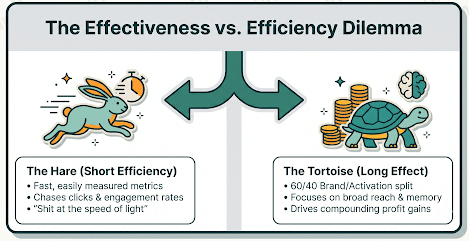
Tindall referenced the fable of the Tortoise and the Hare: efficiency is moving fast, but effectiveness is actually crossing the finish line. “Shit that arrives at the speed of light is still shit,” he argued, urging marketers to prioritise doing the right job before trying to optimise it.
He presented research debunking common short-term metrics:
- Clicks & Engagement Rates Have Zero Correlation to Brand Growth: Meta/Nielsen studies and System1’s research with TikTok revealed no significant relationship between click-through rates or social engagement rates and actual brand memory or market share growth.
- The Attention Spray: Citing Karen Nelson-Field’s research, Tindall explained that higher-attention media channels (TV, radio, cinema) allow creative work to do far more heavy lifting than low-attention digital display placements.
- The 60/40 Rule: Re-affirming Les Binet and Peter Field’s research, 60% of budget should be directed toward broad-reach, long-term brand building, and 40% toward short-term sales activation.
The 4 Pillars of Creative Effectiveness
- Distinctiveness: Brand assets (characters, logos, colours, audio cues) must be instantly recognisable. Distinctiveness turns media spend into revenue. (e.g., Twix “Left vs. Right” ads leveraging the chocolate snap audio cue).
- Emotion: Distinctiveness drives revenue, but emotion drives profit. Running an ad that is both distinctive and emotionally engaging for 3 years makes a brand 7.5 times more likely to report profit gains.
- Showmanship: Drawing on Orlando Wood’s research, showmanship uses character, humour, scene setting, and music to entertain out-of-market audiences (the 95% who aren’t buying today). It outperforms flat, rational salesmanship.
- Consistency: Applying the Compound Creativity Framework (coherence in positioning, culture of consistency across media, and consistent visual execution) builds compounding returns over time. Highly consistent brands achieve 4× higher ROI and are 3× more likely to report incremental profit (e.g., Apartments.com, which has run Jeff Goldblum as its spokesperson for 10 consecutive years).
Key Takeaways from Andrew Tindall:
- Stop Measuring Clicks for Brand Health: Click-through rates measure immediate curiosity, not long-term brand equity or sales conversion.
- Invest in Showmanship: Entertain the 95% of buyers who aren’t in the market today, so your brand is top of mind when they are ready to purchase.
- Maintain Asset Consistency: Marketers tyre of their advertising campaigns long before consumers do. Sticking with core brand assets compounds ROI over time.
5. Agentic Commerce & Reddit SEO
Megan Simons
Country Manager NZ & Pacific, MasterCard
Megan Simons detailed the shift toward Agentic Commerce – where autonomous AI assistants handle research, product selection, negotiation, and payment execution on behalf of consumers.
Simons noted that 71% of surveyed consumers want AI integrated into their shopping experiences, and 58% have already used AI recommendations instead of traditional search engines.
The MasterCard Agent Pay Framework
To make AI transactions secure and trusted, MasterCard developed its Agent Pay Framework around three components:
- Intent Capture: Documenting the exact order parameters specified by the consumer (item, size, colour, budget limit).
- Consent Capture: Explicit authorisation from the consumer permitting the agent to complete the purchase.
- Security (Agentic Tokens & Passkeys): Masking card numbers using single-use tokens and authenticating transactions using biometric Passkeys (FaceID / fingerprint).
Simons demonstrated New Zealand’s first live agentic transactions on stage using an AI assistant:
- Booking movie tickets for Hamnet at Event Cinemas, selecting specific seats and approving payment via FaceID.
- Reserving a Lakeview King room at QT Queenstown within specified dates and budget parameters.
The GEO Strategy
To stay visible as shopping transitions to AI agents, brands must adopt Generative Engine Optimisation (GEO) across four steps:
- Be Found: Ensure product catalogues and store hours are structured for AI search.
- Stand Out: Provide clear, unique brand differentiators that LLMs can digest.
- Be Chosen: Simplify the technical checkout flow so an AI agent can execute payments smoothly.
- Stay Preferred: Ensure member perks and loyalty programs are machine-readable so AI agents factor them into price comparisons.
Key Takeaways from Megan Simons:
- Prepare Data for AI Agents: Ensure product specs, inventory, and pricing are structured cleanly for machine discovery.
- Make Loyalty Programs Machine-Readable: Agents will compare net prices including loyalty discounts; ensure your rewards logic is readable by external systems.
- Emotional Brand Preference Remains Essential: When functional search is handled by AI, strong consumer brand equity is what prompts a user to instruct their agent: “Buy from X brand.”
Richard Conway & Sophie Neate
CEO, The Optimisers & Global Head of Digital Marketing, ABB
This joint session focused on community search, examining how Reddit feeds directly into Large Language Models.
Richard Conway: Search Everywhere Optimisation
Richard Conway shared that 3.8 million Kiwis use Reddit (85.3% of the NZ population over 13 years old). Because LLMs seek unbiased third-party sources to validate answers, Reddit has become one of the most-cited websites by ChatGPT, Perplexity, and Gemini.
Conway introduced the concept of Search Everywhere Optimisation (SEO 2.0): brands can no longer focus solely on Google’s traditional result pages. They must optimise across AI answer engines, YouTube, and relevant community forums.
He issued a stern warning against black-hat Reddit manipulation (such as buying aged accounts, paying for upvote rings, or posting fake reviews through agencies like Red Rover). Platforms and LLMs aggressively penalise manipulative behaviour, citing Google’s historic de-indexing of BMW’s website as a reminder of the long-term penalties associated with short-term hacks.
Sophie Neate: ABB B2B Reddit Case Study
Sophie Neate presented how global industrial engineering brand ABB uses Reddit for B2B growth.
Neate noted that 70% of B2B buyers conduct research via AI search tools, and 40% of AI-generated industrial answers cite Reddit discussions. B2B buyers turn to subreddits like r/engineering and r/electricalengineering to validate technical claims before purchasing.
ABB’s 3-Pillar Execution:
- 70% Organic Engagement: Listening to technical subreddits and having verified engineers answer user questions directly.
- Authority Building via AMAs: Hosting quarterly Ask Me Anything sessions with ABB engineers on topics like safety PLCs, robotics, and energy efficiency.
- 30% Paid Advertising: Running native conversation ads to amplify top-performing technical discussions.
Campaign Results
Focusing on their Food & Beverage drives campaign, ABB achieved 1.38 million global impressions. Myth-busting creative (e.g., “Think drives don’t save energy? Let’s bust that myth”) delivered significantly higher click-through rates than standard product promotion. International markets delivered a 75% higher efficiency rate, with eCPMs in Finland (€1.48) 70% lower than in the US (€2.98).
Neate also shared ABB’s Reddit Language Cheat Sheet for marketers:
| Acronym | Meaning | Usage |
| AMA | Ask Me Anything | Q&A thread hosted by an expert |
| ELI5 | Explain Like I’m 5 | Request to simplify a complex concept |
| TIL | Today I Learned | Sharing an interesting fact or discovery |
| OP / OOP | Original Poster / Original OP | The author of the post |
| TL;DR | Too Long; Didn’t Read | Short summary at the end of a long post |
| YMMV | Your Mileage May Vary | Individual experiences may differ |
Key Takeaways from Richard Conway & Sophie Neate:
- Follow the 90/10 Rule: Spend 90% of your effort answering community questions and adding genuine value, and only 10% on direct promotion.
- Empower Internal Experts: Put real technical leads, engineers, or product managers on Reddit to host AMAs rather than PR spokespeople.
- Avoid Shortcuts: Manipulating votes or spamming subreddits risks permanent bans on accounts and domains.
Summary Table of Speakers & Core Takeaways
| Speaker | Organization | Core Topic | Primary Takeaway |
| Caroline Rainsford | Google NZ | Agentic Era & AI Search | Search queries are running 3× longer; optimise for deep conversational answers via AI Max. |
| Britney Muller | Orange Labs | ML Mechanics & AI Visibility | Ship an “Ugly V1” prototype fast; brand mentions in communities are the new backlinks. |
| Caroline Oates | YouTube | Creator Connection Economy | Creators drive cultural trust; partner with existing brand fans and respect native formats. |
| Dean Napier | Trade Me | Internal AI Cultural Execution | Protect time with “AI Power Hours”; build small specialised agents for manual workflows. |
| Hannah Fillis | Mecca | Community & Social Strategy | Put real store hosts and staff on camera; community is earned by listening first. |
| John Mescall | Dentsu Creative | Emotion & Creative Bravery | Innovation led by emotion creates outrageous impact; AI lifts the floor, humans must raise the ceiling. |
| Megan Simons | MasterCard | Agentic Commerce & GEO | Optimise site specs for GEO; secure agent buying relies on biometric Passkeys and tokens[cite: 4]. |
| Richard Conway | The Optimisers | Search Everywhere & Reddit | 3.8M Kiwis use Reddit; optimise across community search without using manipulative hacks. |
| Sophie Neate | ABB | B2B Reddit Strategy | Combine 70% organic value with expert-led AMAs to influence buyers and AI citation engines. |
| Andrew Tindall | System1 | Creative Effectiveness | Prioritise long-term brand building (60/40 rule); stick with consistent brand assets to compound ROI. |
Unbound’s Honest Review & Event Feedback
Having sat through all nine sessions, here is our team’s honest assessment of Digital Day Out 2026.
The Standout Talks
- Andrew Tindall (System1): Hands down the best structured presentation of the day. Armed with clear data, Tindall challenged industry assumptions, dismantled vanity metrics like click-through rates, and gave marketers a clear blueprint for long-term brand growth. We are all very naughty marketers! Love it!
- John Mescall (Dentsu Creative): Inspiring and memorable. Mescall brought creative craft back to the centre of the conversation, using unforgettable stories (Dumb Ways to Die, Fearless Girl) to prove that emotion remains the ultimate engine of commercial impact.
Middle of the Road
- Dean Napier (Trade Me): Practical and honest. Dean provided a realistic look at how a large Kiwi business manages internal AI adoption, complete with useful operational frameworks.
- Megan Simons (MasterCard): Fascinating technology demonstration. The live-stage demos of agentic buying were impressive, even if widespread consumer adoption is still a few years away.
- Sophie Neate & Richard Conway (ABB / The Optimisers): Solid B2B case study. Showing actual campaign eCPMs and listing specific Reddit subreddits gave the audience concrete, tactical ideas.
Missed the Mark
- Caroline Rainsford (Google NZ): Reiser is a polished presenter, but much of the content felt like a corporate Google product showcase covering features that many digital marketers have already seen multiple times.
- Britney Muller (Orange Labs): The presentation felt somewhat fragmented and revisited much familiar territory on artificial intelligence and AI search capabilities. Furthermore, delivering a highly technical keynote via a live Zoom broadcast created an inevitable gap in the room dynamic, which was compounded by technical disruptions, despite the practical prompts included in her accompanying slide resource.
- Caroline Oates (YouTube) & Hannah Fillis (Mecca): Both speakers shared slick brand overviews, but neither session offered technical depth or actionable digital strategy. They felt more like broad brand showcases than tactical masterclasses.
Key Gaps & Missing Topics
Reflecting on the day as a whole, three major themes were noticeably absent:
1. How Do We Get Past the “AI Slop”?
With five of the nine talks focused on AI, the conference leaned into technology promises. However, nobody addressed the immediate challenge every digital marketer faces today: how do we cut through the massive flood of generic, low-quality “AI slop” filling up search results and social feeds? As tools make content generation effortless, maintaining original creative craft and editorial quality is harder – and more important – than ever.
2. Complete Absence of Data, Privacy & Analytics
For a premier digital marketing conference, there was a total lack of content on core data infrastructure:
- Measurement & Attribution: No deep dives into GA4 server-side tracking, MMM (Media Mix Modelling), or modern attribution setups.
- Data Privacy Laws: A glaring omission given that New Zealand’s updated privacy laws take effect in May 2026. Not a single speaker addressed compliance, zero-party data strategy, or consent management.
3. Narrow Social Channel Focus
Social media coverage was almost entirely restricted to YouTube and Reddit. There was virtually no strategic discussion around Meta (Instagram/Facebook), TikTok, or emerging B2B channels.
Final Thoughts
Digital Day Out 2026 offered a fascinating look at the rise of AI search and agentic commerce. However, the schedule would have benefited from better balance – pairing high-level AI concepts with grounded, tactical sessions on measurement, privacy, and creative execution.
As Andrew Tindall and John Mescall clearly demonstrated, tools and platforms will continue to evolve rapidly, but human emotion, creative distinctiveness, and long-term brand building remain the real drivers of business growth.


