

Have you looked at your Search Terms report lately? I mean really looked at it?
If you haven’t, you probably should. Because there is nothing quite like the feeling of bidding on “commercial office cleaning” and realizing you just paid $15 for someone searching “how to get red wine out of a rug.”
For over a decade, Phrase Match was the safety net of Google Ads. It was the perfect middle ground—not as stifling as Exact Match, but nowhere near the “wild west” chaos of Broad Match. It represented a simple contract between you and Google: if the user types these words in this order, show my ad.
That contract is broken.
At Unbound, we don’t buy into the “just trust the AI” narrative without verifying the numbers first. And the data from late 2024 and 2025 is screaming at us: Phrase Match is dead. It exists in name only.
Here is why we’ve fundamentally changed how we build campaigns, and why the “best practice” strategy you used two years ago is likely burning a hole in your budget today.
The “silent” update: Semantic drift.
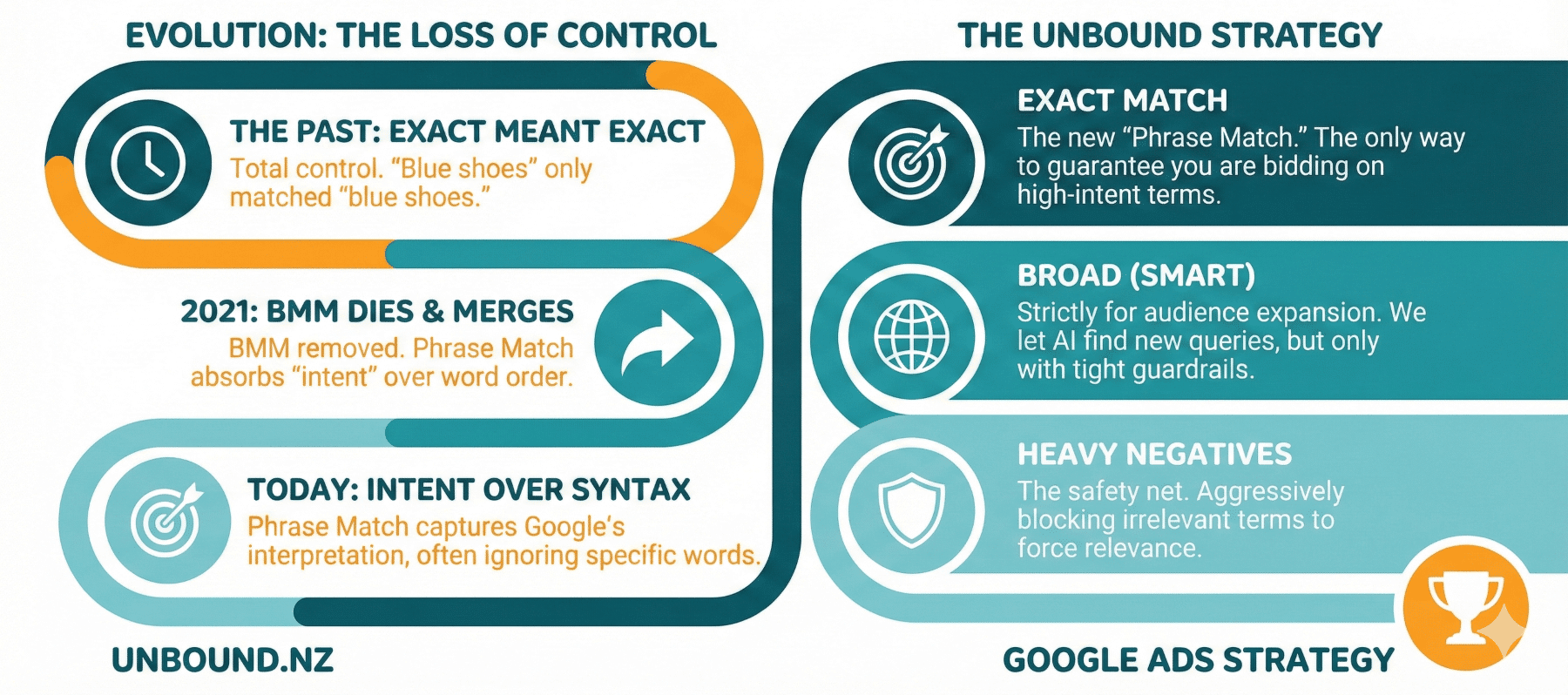
To understand why your campaigns might be leaking budget, you have to look at the timeline. The slide into chaos really started in 2021 when Google killed the Broad Match Modifier (BMM) and merged it into Phrase Match.
They promised us the “best of both worlds.” What we actually got was the looseness of Broad Match without the intelligence to back it up.
Today, Google’s algorithm no longer prioritizes syntax (the words you typed). It prioritizes semantics (what the AI thinks you meant). We call this Semantic Drift.
Let’s say you’re an Arborist. You bid on "arborist services" using Phrase Match.
-
What you expect: Local arborist, tree surgeon near me, consulting arborist.
-
What Google sees: “Tree,” “Garden,” “Outdoor,” “Maintenance.”
-
What you pay for: Lawn mowing, hedge trimmer reviews, garden waste removal.
To Google’s AI, the “intent” is the same—fixing up the backyard. To your bank account, they are entirely different business models. One pays the bills; the other just costs you a click.
The “Valley of Death”.
We don’t make decisions based on gut feel. We look at the hard data. A massive study released in late 2025 by Adalysis analyzed over 16,000 campaigns, and the results confirmed exactly what we’ve been seeing in our own client accounts:
-
Exact Match consistently delivers the lowest CPA (Cost Per Acquisition) and highest ROAS.
-
Broad Match is volatile, but it can work if you have massive data for Smart Bidding to chew on.
-
Phrase Match sits squarely in the “Valley of Death.”
The problem is technical: Broad Match is designed to be loose, but Google compensates for this by giving it access to millions of “Smart Bidding” signals—user history, location, competitors—to decide when not to bid.
Phrase Match is now almost as loose as Broad Match, but—and this is the kicker—it doesn’t use that full range of AI signals. It casts a wide net, catches irrelevant trash, and lacks the algorithmic brainpower to filter it out. It is effectively “Broad Match Lite.”
The Unbound strategy: Pivot to precision.
So, how do we fix this? We’ve flipped the traditional funnel on its head. We generally no longer use Phrase Match as our baseline.
Here is the new playbook we use to drive real commercial results for our clients:
1. Exact Match is the “new” Phrase Match.
Because Google has loosened the rules for everything, Exact Match [keyword] now behaves the way Phrase Match used to. It captures plurals, misspellings, and “close variants,” but it stays tight enough to ensure commercial intent.
We now build the core of our campaigns (often 80%+) on Exact Match. We want to bid on what you actually sell, not what Google thinks is related to what you sell.
2. Broad Match is for discovery (with guardrails).
We only look at Broad Match for audience expansion, and usually only when the Exact Match volume is tapped out. But we never run it “naked.” It’s a scalpel, not a shotgun.
3. The “Heavy Negative” strategy.
If we turn on Broad or Phrase match, we implement a Heavy Negative Keyword Strategy immediately.
Relevance is king. We don’t wait to see what junk queries come through; we preemptively block them. We use N-Gram analysis to find patterns—if the word “cheap,” “training,” “job,” or “DIY” appears, we kill it at the root. We force the AI to stay within a “walled garden” of relevance.
The verdict.
Google will keep expanding match types. They will keep telling you that AI knows your customer better than you do.
We disagree.
In a world of automation, precision is your competitive advantage. By abandoning the broken Phrase Match and doubling down on Exact Match and aggressive negatives, we ensure our clients’ budgets are spent on leads, not on training Google’s algorithm.
Is your Google Ads account still relying on the strategies of 2021? It might be time for a second opinion.


